
TL;DR
- What it does: CLI + optional web UI for wallets, approvals, swaps (with retries), tx inspection, and basic monitoring.
- Who it’s for: A private playground for execution ergonomics and reliability tactics.
- Biggest result: faster iteration on end-to-end execution flows (metrics depend on RPC quality + liquidity).
Context
I wanted a small, private codebase to prototype BSC/PancakeSwap execution flows end-to-end: wallets, approvals, swaps, and lightweight “watch” tooling.
Constraints: this is intentionally not a public repo. It’s a single-dev PoC focused on iteration speed, not a production trading system (no hosted infrastructure, no “bot-as-a-service”, no secrets committed).
Problem
On-chain execution is latency-sensitive and failure-prone: RPCs can stall, approvals are easy to forget, and manual workflows (tx copy/paste + receipt checking) are error-prone.
Existing approaches didn’t fit what I wanted: either too heavyweight (full trading frameworks) or too opaque (black-box bots). I needed something hackable that makes the execution flow explicit.
Goals (and non-goals)
Goals:
- A CLI that can do the basics quickly: balances, approvals, swaps, tx inspection, and a couple of monitoring loops.
- Experimentation with retry tactics (send/retry with controlled nonce/gas strategy) and multi-RPC connectivity.
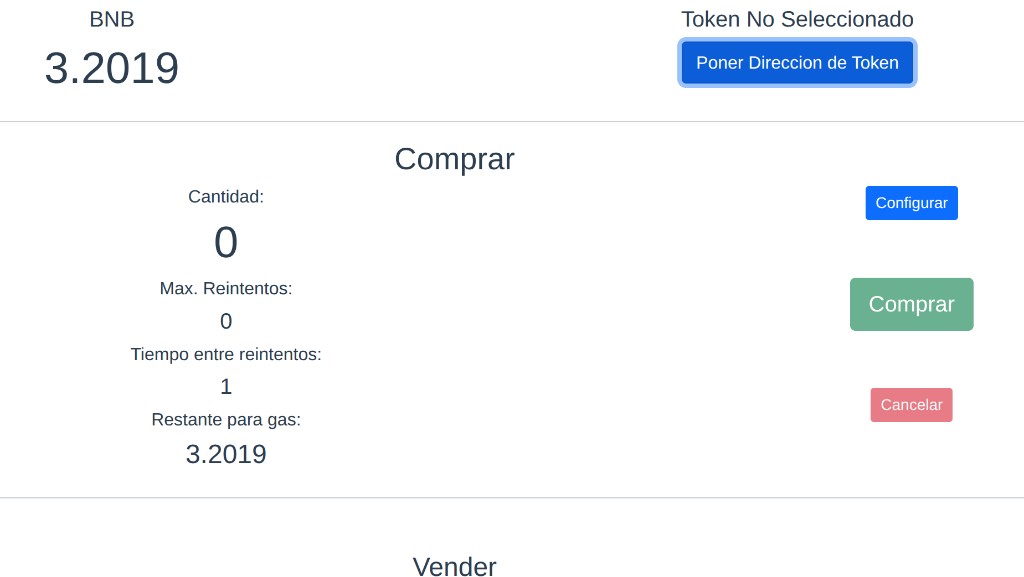
- A minimal web API/UI to trigger and observe a buy/sell flow in a more “dashboard-like” way.
Non-goals (optional):
- Production-grade safety guarantees (key management/HSMs, extensive backtesting, strategy research tooling).
- Publishing keys, wallet files, addresses, or private endpoints in docs.
Solution Overview
I built a Python CLI around a small PancakeSwap interaction layer (router/factory/wallet/transactors), then added a “fast swap” retrier for controlled re-attempts.
Separately, I added a lightweight FastAPI service (plus a Vue frontend) to trigger buy/sell orders and poll execution status.
High-level Architecture
[CLI (click)] ------------------------------+
    |                                      |
    | calls                                | calls
    v                                      v
[PancakeSwap interaction layer]       [FastAPI API] <--- [Vue UI]
    | (router/factory/wallet)              |
    |                                      |
    v                                      v
[RPC Connection Pool / Transactors]    [Local file storage for orders/status]
    |
    v
[BSC RPC nodes] --> [PancakeSwap contracts + token contracts]
Stack
| Layer | Tech |
|---|---|
| Frontend | Vue (in webui/vue/app) |
| Backend | FastAPI (in webui/fastapi) |
| Device/Client | Python CLI (click) in cmd/ |
| Data/Storage | Local file storage for PoC state (and SQLite for some analysis flows) |
| Networking | Web3.py over HTTP RPC (BSC nodes via a small connection pool) |
Key Implementation Details
Core flow
- Load wallet file (JSON) and derive checksummed address.
- Resolve token address (symbol mapping or checksum address).
- Ensure approval when needed (token allowance to Pancake router).
- Build swap order (input token, output token, amount, optional fixed output).
- Execute via a transactor (normal, multi-conn, or fake/reporter) and track the resulting tx hash.
- Inspect receipt status later with
txcommand or via API polling.
Design choice: explicit composition
I kept execution logic explicit and modular: “wallet + transactor + router + order” rather than hiding everything behind a single mega-command. It’s more verbose, but it makes it easier to swap in alternative nonce/gas strategies or different RPC selection policies.
Performance / reliability
- Connection pooling: pick “fast” RPC connections for polling/filters and isolate slower nodes.
- Retries: a dedicated fast-swap retrier can re-attempt execution with controlled delays.
- Failure visibility: CLI helpers print tx hashes and a follow-up command to inspect receipts.
Demo / Results
- CLI-driven buy/sell flows (token approve → swap → tx receipt check).
- Monitoring loops (price quotes, transfer-event volume buckets).
- API-driven execution (configure order → execute → poll → sell).
Notes on metrics:
- End-to-end “execute → mined” varies widely; RPC quality and token liquidity dominate.
- The main operational metric was time-to-first-tx-hash (submission speed).
What improved
- Reduced manual steps (approvals, tx lookup, repeated quoting).
- Faster iteration on execution strategies in one contained codebase.
Challenges
- RPC instability and inconsistent latency.
- Fix: connection pooling + switchable transactors + retry-based execution paths.
- Outcome: fewer dead ends and faster diagnosis when calls fail.
Lessons Learned
- Execution is mostly “systems engineering”: latency, failure modes, and observability matter as much as contract calls.
- Keeping flows composable (wallet/transactor/router/order) makes experimentation easier.
Future Work
- Add safer config handling and clearer separation of “demo” vs “real” execution modes.
- Improve metrics (structured logs, timestamps, success/failure counters).
- Harden the FastAPI storage model (schema/versioning; avoid hardcoded wallet aliases).